
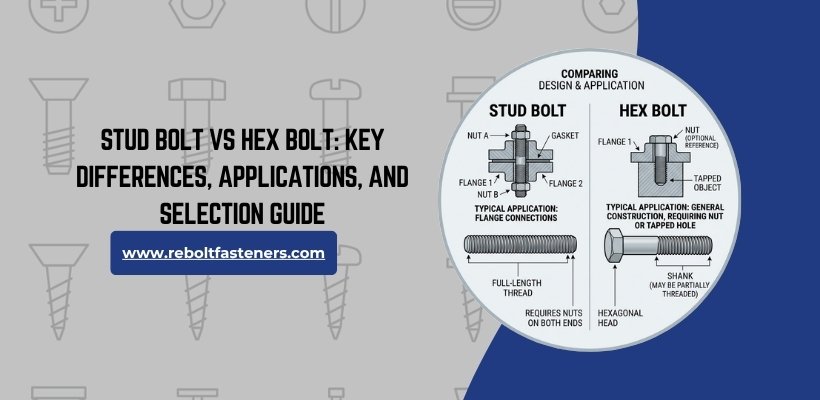
Stud Bolt vs Hex Bolt: Key Differences, Applications, and Selection Guide
Understanding Fasteners: Why Choosing the Right Bolt Matters
Fasteners are important in achieving the structural integrity and the performance of mechanical assemblies. The most used ones include stud bolt vs hex bolt among the most popular types of bolts; they are used in the automotive, construction, oil and gas, and heavy engineering industries. But choosing the wrong type may cause maintenance problems, joint failures, or extra expenses.
This manual simplifies and is practical for comparing a stud bolt and hex bolt. You will also get to know the purpose of stud bolts, the purpose of hex bolts, the difference between them, their size and which applications they are best suited to. The article is relevant in that you can make well-informed fastening decisions regardless of whether you are an automotive engineer or a procurement manager.
What Are Stud Bolts?
Stud bolts are threaded rods that are also without a head, and are normally threaded on either end or all through the length of the rod. They are screwed to the ends of two nuts, one at each end, to fix components.
Key Features:
- No head, threaded, wholly or partly.
- Requires nuts on both ends.
- Can be of a double-end design, a tap-end design, or completely threaded.
Common Applications:
- Piping connections of flanges.
- Slaughterhouse-Five is set in high-pressure and high-temperature conditions.
- Mechanical components and machinery.
What Are Hex Bolts?
The thread of the shaft and the head of the bolt are hexagonal and are referred to as hex bolts. They are attached with a wrench or socket, and they are usually fitted with a nut or tapped hole.
Key Features:
- The easy-to-tighten head is hexagonal.
- Partially or fully threaded.
- They come in different grades and finishes.
What Are Hex Bolts Used For?
- General building and structural use.
- Automotive assemblies.
- Installation of machinery and equipment.
Difference Between Stud Bolt and Hex Bolt
Understanding the difference between stud bolt and hex bolt is essential for selecting the right fastener for your application.
| Feature | Stud Bolt | Hex Bolt |
|---|---|---|
| Design | Headless, threaded rod | Hexagonal head with threaded shaft |
| Installation | Requires two nuts | Uses one nut or tapped hole |
| Load Distribution | Even load across both ends | Load concentrated at head |
| Maintenance | Easier disassembly | Slightly harder in tight spaces |
| Applications | High-pressure systems | General-purpose fastening |
| Strength Performance | Better for dynamic loads | Suitable for static loads |
Stud Bolt vs Hex Bolt: When to Use Each
Choose Stud Bolts When:
- You require an equal distribution of loads.
- Frequent disassembly is used in the application.
- Use of flanges or high-pressure joints.
- There is a concern of thermal expansion.
Choose Hex Bolts When:
- You require a fast and easy setup.
- Space enables easy accessibility of tools.
- The application involves static loads.
- Cost-effectiveness is a priority.
Hex Bolt Size Chart in mm
Hex bolt sizes are typically measured by their diameter, length, and thread pitch. Here is a standard hex bolt size chart in mm for common metric sizes:
| Nominal Diameter (mm) | Major Diameter (mm) | Minor Diameter (mm) | Recommended Drill Size (mm) |
|---|---|---|---|
| M3 | 3.00 | 2.50 | 2.6 |
| M4 | 4.00 | 3.30 | 3.3 |
| M5 | 5.00 | 4.20 | 4.2 |
| M6 | 6.00 | 5.10 | 5.2 |
| M8 | 8.00 | 6.80 | 6.9 |
| M10 | 10.00 | 8.50 | 8.6 |
| M12 | 12.00 | 10.30 | 10.4 |
| M16 | 16.00 | 13.80 | 14.0 |
| M20 | 20.00 | 17.30 | 17.5 |
Hex Bolt Types
There are several hex bolt types, each designed for specific applications:
- Hex Cap Screws: These are the most common type, featuring a hexagonal head and a partially threaded shank.
- Hex Machine Screws: These are fully threaded and used with nuts or tapped holes in machinery.
- Hex Lag Screws: These have a coarse thread and are used for wood applications.
- Hex Flange Bolts: These have a built-in washer that distributes the load over a wider area.
Stud Bolt vs Hex Bolt: Which is Better?
The choice between a stud bolt and hex bolt depends entirely on your application requirements. Stud bolts are superior for high-pressure, high-temperature, and frequently disassembled joints, while hex bolts are ideal for general-purpose, cost-effective fastening where ease of installation is a priority.
Conclusion
Understanding the difference between stud bolt and hex bolt is crucial for making informed decisions in engineering and construction. Both fasteners have their unique strengths and applications, and choosing the right one ensures the integrity and longevity of your assemblies.
FAQs
Q1: What are the main advantages of using stud bolts over hex bolts?
Stud bolts offer better load distribution, easier disassembly, and are ideal for high-temperature and high-pressure applications where thermal expansion is a concern.
Q2: Can I use hex bolts in place of stud bolts in my application?
Only if the application involves static loads and does not require frequent disassembly. For critical applications, it is best to stick to the specified fastener type.
Q3: What is the difference between a double-end stud bolt and a tap-end stud bolt?
A double-end stud bolt is threaded on both ends, while a tap-end stud bolt has threads on one end and a pilot point on the other for easier installation.
Q4: Are hex bolts suitable for automotive applications?
Yes, hex bolts are widely used in automotive assemblies for general fastening where high-pressure or high-temperature conditions are not a primary concern.
Q5: How do I determine the correct hex bolt size for my application?
You can use the hex bolt size chart in mm provided above, or consult with a fastener specialist to ensure you select the appropriate diameter, length, and thread pitch for your specific needs.
Contact Us
Looking for high-quality stud bolts or hex bolts for your next project? Contact us today for a custom quote or email us at sales@reboltfasteners.com. Our team of experts will help you find the perfect fastener solution for your specific application.