
Why Understanding Fastener Differences Matters More Than You Think?
One of the most misconstrued issues in hardware and construction is the difference between a nut, a bolt, and a screw. Firstly, these fasteners might seem similar; however, their design, the way of installation, and their applications differ greatly. Bringing together some furniture as a beginner DIYer, a contractor working with structural projects, or a hobbyist playing with materials, the question always arises: which fastener to use to provide safety, durability, and performance?
Misuse of the type may result in weak joints, ripped threads, or even total structural breakdown. This tutorial will enable you to have a clear idea of the difference between nuts, bolts, and screws so that you can always choose the appropriate fastener to use on metal, wood, plastic, electronics, or even 3D printing projects.
Nut vs Bolt vs Screw: What’s the Basic Difference?
The distinction between these fasteners at the basic level is the way they work and how they interrelate:
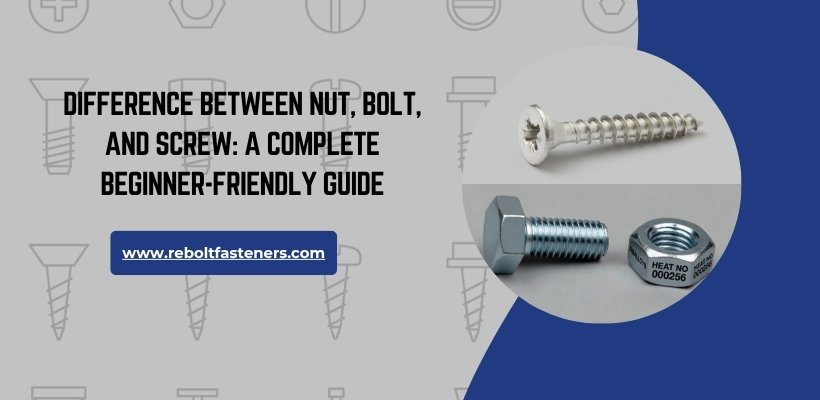
- Bolt: Used with a nut for the strong and secure joining of materials.
- Screw: Directly fastens into material without needing a nut in most cases.
- Nut: A female threaded fastener that is used together with a bolt.
Are You Torquing the Head or the Nut? Fastener Mechanics Explained
One of the simplest methods to think of nut vs bolt vs screw is in how they are tightened:
- Bolts normally fit in holes that have been pre-drilled and tightened by turning the nut.
- Screws are driven directly into the material by rotating the head.
- The assembly is secured by tightening the nuts around the bolts.
This is a key difference in applications, whereby load distribution and clamping force are significant.
Nut vs Bolt vs Screw Chart
| Feature | Bolt | Screw | Nut |
| Threads | External | External | Internal |
| Installation Method | Torquing Nut | Torquing Head | Torqued onto Bolt |
| Requires Pre-threading | Yes (hole + nut) | No (self-threading possible) | Used with a bolt |
| Primary Use | Heavy-duty fastening | Direct fastening into the material | Securing bolts |
This Nut vs Bolt vs Screw chart gives a quick overview for easy comparison.
Nut vs Bolt vs Screw for Metal, Wood, and Plastic
For Metal
- Metal applications where a high clamping force is needed are best done with bolts and nuts.
- In cases where threads are tapped into, metal machine screws are also used.
For Wood
- The most suitable ones are the screws because they are capable of cutting their own threads in wood.
- Washers and nuts can be employed with heavy structural joints with bolts.
For Plastic
- To prevent cracking, self-tapping screws are usually employed.
- When reinforcement is required, bolts with nuts can be used.
For Electronics
- Individual machine screws and nuts are employed to assemble the machine very precisely.
- Screws can also be used in conjunction with threaded inserts.
For 3D Printing
- Printed parts are normally assembled with screws.
- There will be nuts in the designs to enhance strength.
Learning about ? Nut vs Bolt vs Screw for electronics, plastic, metal, wood, and 3D printing can assist in making sure that it is feasible to use adequate fastening without harming the products.
What About Machine Screws? Are They Bolts?
This is where misunderstanding is likely to occur in the difference between Nut and Bolt and Screw argument.
- Machine screws refer to screws in the technical sense of the word, in that they are moved by their head.
- They can, however, be applied as bolts when applied with a nut.
So they might overlap in application; however, they are classified by the way they are mounted and not only by their shape.
Nut vs Bolt vs Screw PDF: Why Visual Guides Help
These guides usually have diagrams, thread types, and size charts.
- This information makes it easier to choose the fastener for a job.
- A nut vs bolt vs screw PDF is really useful in construction and engineering work.
- In these fields, making decisions and using the right fasteners is crucial for strength and safety.
- Such resources help professionals get the job done correctly.
- They rely on these guides to ensure accuracy.
- The guides are a tool for workers.
- They make it simple to identify and select the fastener.
- This is especially important in construction and engineering.
- Workers use these guides to make sure they are using the fasteners.
Important Points: Bolt vs Screw vs Nut
- The screw is self-threading and best suited to be directly inserted into materials.
- A nut is used to fix and hold things together using bolts.
Finally, the distinguishing factor usually lies in the fact that the fastener may or may not need a mating nut or may be able to thread directly into the material.
FAQs
Q1. What makes screws ideal for furniture work?
Screws are great for making furniture. They make their holes and grip the material tightly. This makes joints in furniture very stable. It does not hurt the surface of the material.
Q2. Why are nuts important in assemblies?
Nuts are important in assemblies because they ensure the secure locking of bolts. This prevents loosening due to vibration. Maintains joint stability. Nuts keep everything in place.
Q3. What happens if the wrong fastener is used?
Using the fastener can cause many problems. The joint may not be strong. The threads can get damaged. It can loosen when something vibrates. The whole structure can even fail.
Need good quality Nuts, Bolts, and Screw? We have the good prices. Contact us or email us sales@reboltfasteners.com at today